Dawn, and the rangers who forbid these forays slumber. Through a screen of bamboo, a sheen of silver water and vapor like smoke from a cauldron simmers. The far bank a vague whiteness. Nothing moves but the rising mist, all living things unstirred and in hiding.
Mudumalai is only two hundred kilometers from Bangalore, but light-years away in spirit. Working in India’s IT hub, I had taken to cycling in the dead of night to escape the chaos, pedaling deserted streets, returning at dawn to sleep away the hot hours in a house I shared with six friends.
And now, at the Moyar dam, the morning is the start, not the end—as it should be.
A ripple of water in the reeds.
Five, curious whiskered faces: otters. They submerge and this marks the start of our game —we travel only when lost to each other’s sight. When they swim unseen, I walk, and the same bemused stares each time.
We reach the dam wall at the same time, the thinning mist reveals the opposite bank and a dark smudge in the water.
A lone elephant. Made tiny by the jungle foliage, an artist’s flourish on a larger canvas.
A look through binoculars reveals an intricate bath is taking place. Spiralled trunk curled seductively back, water deposited, and then a pause with the trunk held erect in an exhibitionist pose. The cycle repeats, even slower this time, with the rhythmic fanning of the ears the cooling breeze. The animal’s languor could match any spa-goer for indulgent pleasure. The mist could be the steam in a Turkish sauna, the scene scented by a perfumed fragrance. Sitting cross-legged on the ground, warmed by the sun, there is a sublime moment when the otters appear for one last time in the foreground, with the elephant unaware under a purple sky. I could not feel more unburdened by worries, more content.
Departing his bath, distance cancels sound, and the elephant merges with the undergrowth like something insubstantial, like the morning mist cloaking him moments before.
*
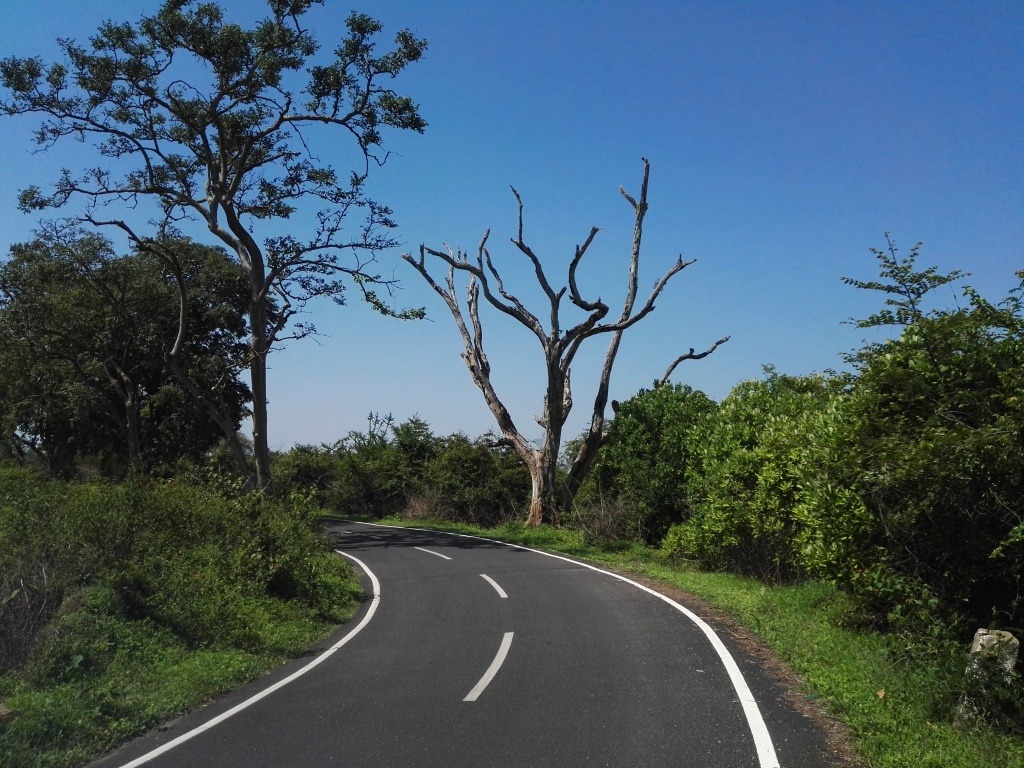
At midday on the plains, the colour palette has shifted to a green so bright it stings the eyes. The Nilgiri hills loom crisp, ravines where leopards make their dens lie in faintly shadowed valleys. The arc I had started at the dam should return me to the small village of Masinagudi before nightfall.
Tourist in tiger country trampled to death by cattle is the potential, ludicrous headline when a herd, whose similarity to buffalo unnerves me, materialise from all sides. This discomfort vanishes when the old drover appears, skin like hazelnut, leaning on a knotted staff that might belong to an ancient sage. Perhaps he is. What store of wisdom he must have built up in this rambling life. We stare at each other and smile, the only thing we can do apart from wander in silence, me grinning at the oddity of our pairing, the land’s lushness and the joyful blue of the sky. He nibbles at the biscuits I proffer in farewell and is soon swallowed by the undulating land.
Later in a shady spot by the river a group of boisterous lads from Tamil Nadu interrupt my reverie. They are on a 4×4 adventure of their own: loud, brash, happy to be out of the city. My fumbling Hindi, designed to impress, draws a friendly but firm denial of any understanding of that “wicked” North Indian language. Their loud banter is good-humored, but jars the serenity. Despite not sharing a language, perhaps I have more in common with my wandering drover, and I think of him with affection.
*
This river sojourn has eaten time, and there are things here which eat more than that. The hour of the big cats has come. Hugging the road back to town, my body tenses with a ready expectation. The sky is reddening, not the pink of dawn, but a fierier shade, a last bloodletting perhaps before night.
Turning into a glade, I stop short.
Half-turned, flank quivering in spasmodic jerks, not a tiger but a huge sambar stag framed against a tree. His eye catches mine—wild, terrified. His petrified gaze holds me for three, four, five mad seconds, before thumping away.
The diminishing pattering of his hooves is an invitation.
My tracking skills are poor, but a huge, spreading banyan tree in a thicket has space enough to perch. The idea of sleeping to the murmur of nocturnal things seems a fitting end to the day.
But the crimson dusk soon surrenders to a vague world of indistinct forms, a night chill in the air too. Then a squawk, an eruption of loose feathers—a bird’s panicked escape from a tangle of thorns. The ringing silence which follows insists more than words that I leave. I depart in a hurry, spooked at the den which holds no obvious threat. It is the shortest of journeys to the village, but the faces of its inhabitants and Kingfisher beers never more welcome.
*
Propping my bedding against the concrete wall of a Hindu temple, I feel mildly ashamed at my reaction in the thicket.
The day had been marked by intense, primal reactions. It reminded me of what Paul Theroux said, that the “intense privacies” of travel shape our unfiltered responses on the road. It was true today.
The dawn at the dam was untainted by the glib exclamations we sometimes feel necessary when sharing a moment—“isn’t this incredible, guys?”
When I followed the stag a kind of summit fever took hold, a temporary desire to be untethered from safety, and to make this choice I needed no permission from a fellow hiker who may have argued justly against such an action.
In the thicket there was no reassuring word from a friend to rid night of its menace.
Was my mute cattle-herder prone to such mood swings?
No, he wasn’t. And neither was our unglimpsed tiger. But they were secure here, part of this place. The tempo of their lives, the pad of paw on soft earth, beat of staff on rutted track, inseparable from the rhythm of the land itself. I was passing through, my rising and falling heartbeats the modern man’s skittish reaction to a place he didn’t know.
But what a place to pass through, what a paradise to be a stranger in.


Leave a Reply